When additive manufacturing meets mechanical precision
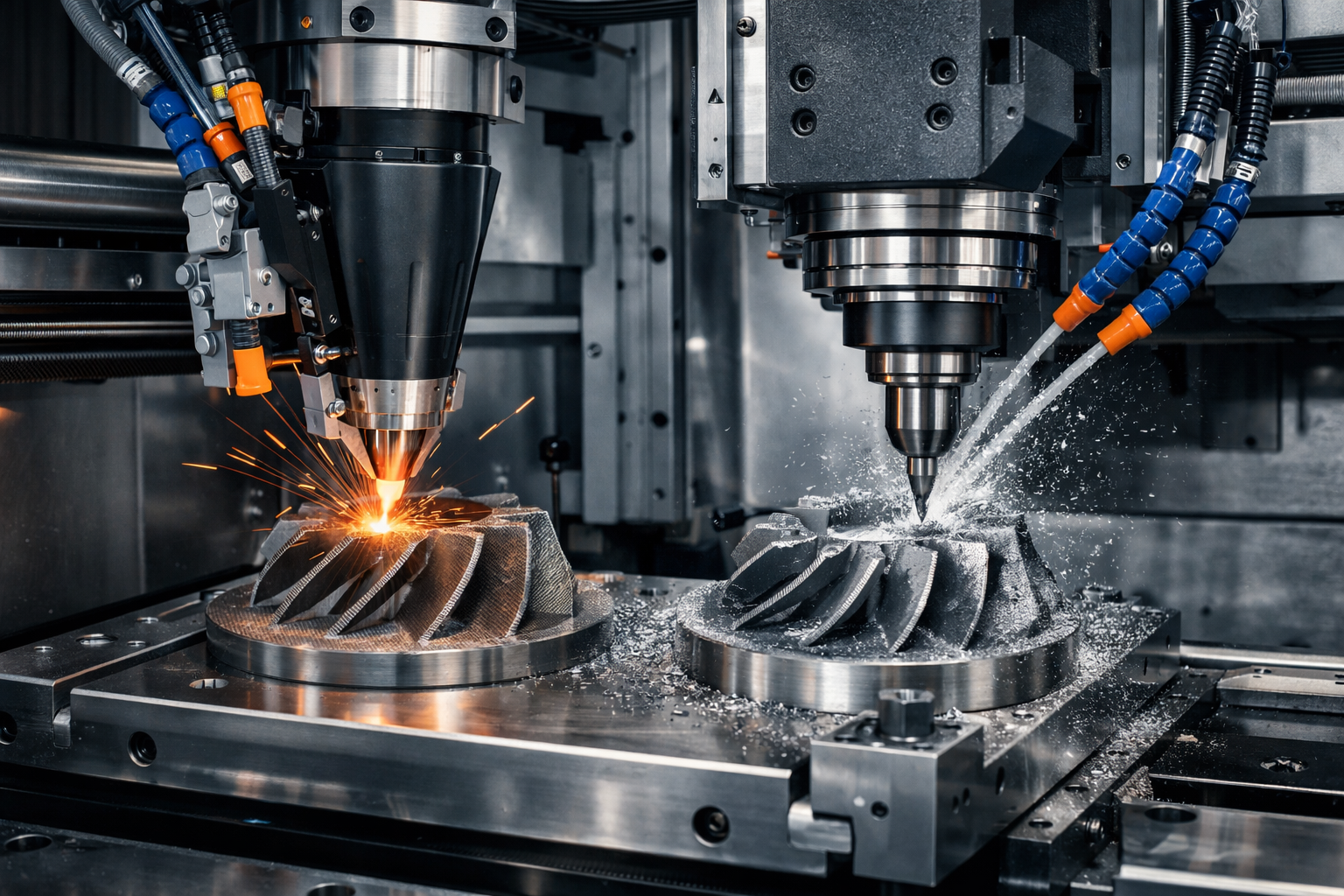
The boundary between additive manufacturing and traditional machining is becoming increasingly blurred. Today, the challenge is no longer to choose one over the other, but to combine them intelligently in order to leverage the best of both worlds.
3D printing enables the rapid creation of complex, lightweight, and optimized geometries. CNC machining, on the other hand, provides the rigidity, dimensional accuracy, and surface finish required for functional parts.
For design offices and prototype engineers, this hybrid approach represents a natural evolution from rapid prototyping to functional prototyping.
Choosing the right materials for machining: stability above all
Not all polymers are suitable for post-machining operations. Standard materials such as PLA or pure ABS often exhibit too much flexibility or insufficient internal structure to withstand cutting forces.
Short-fiber–reinforced composites, by contrast, provide an excellent base material.
Carbon fiber (CF) and glass fiber (GF) formulations significantly improve stiffness, dimensional stability, and heat resistance. These properties make it possible to produce printed blanks capable of withstanding milling operations without deformation or material tear-out.
The most effective materials in this context include PA-CF / PA-GF, ABS-CF / ABS-GF, PETG-CF, as well as high-performance polymers such as PEEK-CF and PEKK-CF.
Thanks to these composites, printed parts can be clamped, machined, and reworked with tolerances on the order of a few hundredths of a millimeter, without interlayer failure or excessive vibration.
Preparing the print for CNC post-machining
For CNC machining to be effective, the part must be designed from the outset as a printed blank intended for post-processing.
This means planning solid regions where the cutting tool will machine functional surfaces or bores.
Modern slicers such as Bambu Studio, PrusaSlicer, or OrcaSlicer allow the definition of local infill modifiers. This makes it possible to enforce 100% infill only in areas that will be machined, while maintaining lightweight infill elsewhere.
This approach prevents layer collapse or tear-out during milling while preserving the overall lightness of the part.
It is also essential to account for machining allowance (typically between 0.2 and 0.5 mm) to ensure a perfect surface finish after post-machining.
Finally, print orientation should minimize interlayer stress in critical zones. A surface to be machined is better oriented perpendicular to the layer lines rather than parallel to the build plate.
From printed canvas to functional part
Once the part is printed, the machining process closely resembles a conventional operation, with one key difference: the printed part is lighter and sometimes less rigid than a solid block.
Careful fixturing is therefore essential to prevent deformation. A simple jig or flat support is often sufficient, especially when using rigid composites such as PA-CF.
The workflow is straightforward:
- Printing the blank with integrated machining allowance.
- Mounting the part on the CNC machine using predefined alignment references.
- Machining critical areas: bearing surfaces, drilled holes, bearing seats, or mechanical interfaces.
This process enables the production of highly complex parts in a reduced timeframe. Most of the volume is created through 3D printing, while CNC machining is limited to areas where precision is critical.
Time savings can reach 70 to 90% compared to fully machining a solid block, while maintaining equivalent precision on functional features.
The convergence of technologies
An increasing number of manufacturers are embracing this hybrid approach, offering solutions that combine material deposition and precision machining within a single platform.
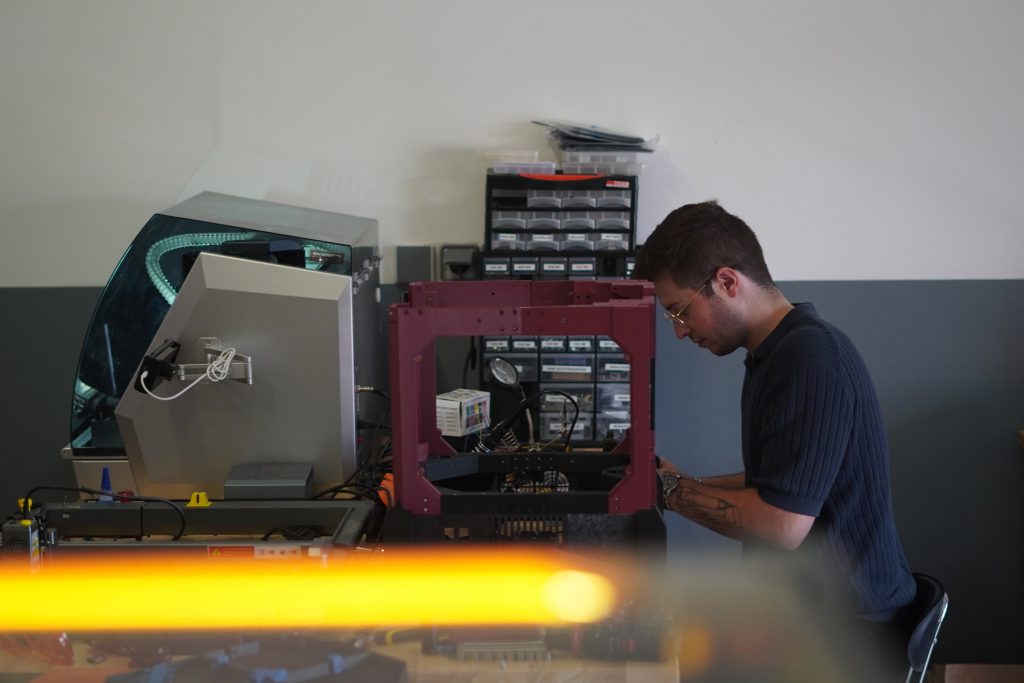
The French company 4Dpioneers perfectly illustrates this trend with its 4Shift and 4Prime machines.
These systems combine multi-material additive manufacturing with integrated finishing tools, enabling unprecedented precision and surface quality directly out of the machine.
- The 4Shift is a modular platform designed for rapid prototyping and small-batch production, capable of automatically changing tools to switch from extrusion to finishing operations.
- The 4Prime, more production-oriented, goes even further with high-precision mechanics and an open architecture compatible with multiple manufacturing processes.
These machines embody the practical fusion of 3D printing and CNC machining, making it possible to produce hybrid parts directly, without transferring them between separate workstations.
Best practices and limitations
Despite its advantages, this approach requires rigor and careful planning.
Materials must be dry and homogeneous, fixturing must be well designed, and cutting speeds must be adapted to the material’s density, which is lower than that of a solid block.
It is also important to limit the number of machining setups and to concentrate machined surfaces on a single plane to simplify positioning.
The goal is not to replace CNC machining with 3D printing, nor the reverse, but to reduce machining time and increase flexibility in product development.
Conclusion
Combining 3D printing and CNC machining is no longer an experimental approach, but a recognized method within the most agile engineering teams.
3D printing provides design freedom and rapid execution; CNC machining delivers precision, surface quality, and mechanical compatibility.
With composite materials such as PA-CF, PA-GF, or ABS-CF, and with the emergence of hybrid solutions like the 4Shift and 4Prime from 4Dpioneers, this synergy is becoming a new industrial standard.
Rapid prototyping is evolving into functional prototyping, ready to meet the demands of modern engineering.